
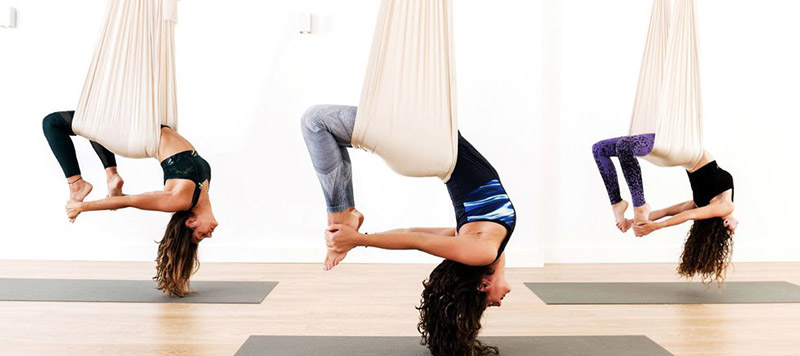

Clothing for a suspended class has a different job from clothing for a treadmill session. The outfit still needs to manage heat and sweat, but it also sits between the body and a load-bearing hammock. Coverage, seam placement and fit can affect comfort, movement and confidence every time the fabric wraps around the legs, hips or torso.
For aerial yoga, the most useful activewear is not necessarily the trendiest or most compressive. It is clothing that stays in place while inverted, protects common contact areas and lets the instructor see enough body alignment to guide movement safely.
The Hammock Creates Unusual Contact Points
During mat exercise, clothing mainly moves against the skin and floor. In an aerial class, the hammock may gather behind the knees, under the arms, across the pelvis or around the waist. Body weight can increase pressure and friction at these points.
Bare skin is not automatically unsafe, but it may feel pinched, rubbed or irritated during repeated transitions. Coverage provides a consistent layer between skin and fabric. This is why many classes recommend leggings and a top that protects the underarm area rather than shorts and a low-cut vest.
Leggings Usually Offer More Protection Than Shorts
The backs of the knees are common hammock contact areas. Full-length leggings cover this sensitive fold and protect the thighs and lower legs during entries, exits and wraps. Cropped leggings may also work if the exposed area does not sit under the fabric, but that depends on the class.
Shorts leave more skin available for friction. Loose shorts can also shift or reveal more than intended during inversions. If a participant strongly prefers shorts, fitted longer styles may be more manageable, but studio guidance should take priority.
Leggings should stretch through deep hip and knee flexion without becoming restrictive. They should also recover their shape. Material that bags behind the knees can bunch under the hammock, while a waistband that rolls may create an uncomfortable ridge beneath pressure.
Tops Need to Stay Put When the Body Turns Upside Down
A top that performs well while standing may slide towards the shoulders during an inversion. This can distract the participant, expose the abdomen or interfere with a wrap around the torso.
A close, comfortable fit usually works better than a loose T-shirt. The hem should remain reasonably secure without gripping so tightly that breathing feels restricted. A bodysuit is not required, and extreme compression does not guarantee better performance. The aim is reliable coverage through reaching, folding and rotation.
Sleeve choice depends on comfort and class content. Short sleeves can protect the underarms better than narrow straps. Some participants prefer fitted long sleeves for additional coverage, especially when learning wraps. Sleeves should not be so loose that they twist, catch or hide hand placement.
Necklines matter too. A secure neckline reduces the need for adjustment in inverted positions. Participants can test this at home by bending forward, raising both arms and gently rotating. If the top immediately moves out of place, it is unlikely to become more stable in a hammock.
Fit Should Be Close, Not Punishing
Very loose garments can obscure limb position, fold beneath the fabric or catch during transitions. Excess material may also make it difficult for the wearer to see whether the hammock is lying flat.
At the other extreme, an outfit can be too tight. Restrictive waistbands, stiff panels and aggressive compression may feel uncomfortable when the hammock adds pressure. Clothing should allow a full breath and unrestricted shoulder and hip movement before the class begins.
Seam Placement Can Change Comfort
Flat, smooth seams are often more comfortable under pressure than bulky raised ones. A prominent seam positioned at the back of the knee, inner thigh, underarm or side waist can be pressed into the skin by the hammock.
Pockets may create similar issues. A phone pocket is helpful outdoors but may add layers exactly where the fabric wraps around the thigh. Remove all objects before class, and consider whether zips, toggles or hard pocket edges could contact the hammock.
Decorative mesh can increase ventilation, but its edges may feel rough under compression. Cut-outs reduce coverage where protection may be useful. These features are not automatically unsuitable, yet they should be evaluated according to contact and movement rather than appearance alone.
Avoid Hardware That Can Damage Skin or Fabric
Exposed zips, metal studs, sharp fasteners and abrasive embellishments can press into the wearer or snag the hammock. Hook-and-loop closures may catch delicate fabric. Clothing with smooth surfaces and minimal external hardware is generally a safer choice.
Jewellery requires the same attention. Rings, bracelets, watches, necklaces and large earrings can catch, scratch or become compressed. Removing them protects both the participant and the equipment. Hair clips with sharp teeth or metal edges may also be unsuitable, so long hair is better secured with a simple soft tie.
This is not only an equipment-care rule. A caught necklace or ring can pull suddenly when body weight shifts. Taking accessories off before the briefing is easier than attempting to remove them after the hands are warm or swollen.
Surface Texture Affects Movement
Extremely slick clothing may slide against the hammock more than expected. This does not mean activewear needs a sticky coating, but a smooth, controllable fabric can make wraps feel more predictable. Very rough textures may grip aggressively or abrade the hammock, so more friction is not always better.
Fabric thickness changes sensation as well. A thin legging may feel cool but provide little cushioning at concentrated contact points. A very thick garment may trap heat and create bulky folds. A medium-weight, flexible material is a useful starting point for many students.
Opacity Matters in Deep Flexion and Inversion
Stretch fabric can appear opaque while standing and become sheer in a squat or hip fold. Strong studio lighting can make this more noticeable. Checking leggings in natural and bright light through a full squat provides a better test than looking in a mirror while upright.
Singapore’s Climate Changes the Trade-Off
Full coverage may sound uncomfortable in a warm, humid environment. Breathable, moisture-managing fabrics help balance protection with temperature. Lightweight long leggings and fitted sleeves can provide coverage without relying on heavy material.
Cotton may feel soft but can hold sweat and become heavy. Technical synthetics often dry faster, although individual skin sensitivity and preferences differ. Whatever the fibre, clean clothing helps protect shared equipment and improves comfort for the wearer.
Dress for the Actual Class, Not the Category
An introductory session may use different wraps from an advanced class, and studio policies can vary. Read the provider’s instructions before arriving. If guidance is unclear, ask about sleeve length, leggings, grip socks and prohibited accessories.
Some participants need adaptations for religious dress, scars, sensory comfort, medical devices or skin conditions. These conversations are best held privately in advance so the instructor can consider both inclusion and safe hammock interaction.
At a class provider such as Yoga Edition, students can confirm practical clothing expectations before their visit. That small step prevents arriving in an outfit that limits participation.
The best aerial activewear is easy to forget once class starts. It covers high-contact areas, moves without shifting, avoids hard details and remains comfortable under pressure. When clothing performs quietly, attention can stay on technique and the experience of moving with the hammock.
Frequently Asked Questions
Can I wear shorts to aerial yoga?
Studio rules vary, but full-length leggings usually protect more skin at the backs of the knees and thighs. Shorts may allow uncomfortable friction.
Do I need long sleeves?
Not always. A fitted top that covers the underarms may be sufficient, while long sleeves can add protection for some wraps.
Why are zips and jewellery discouraged?
Hard or sharp items can press into the body, catch during movement or damage the hammock. Smooth clothing without accessories is preferable.
Should aerial yoga clothes be tight?
They should be close enough to stay in place without restricting breathing or movement. Extreme compression is unnecessary.
Can I wear grip socks?
Ask the studio. Bare feet may provide useful contact in some classes, while approved grip socks may suit others.
What should I bring as a backup outfit?
Bring fitted leggings and a secure top with underarm coverage, plus a soft hair tie. A dry change of clothes is useful in humid weather.